
ZZZ Drive Discs: Main Stats, Set Bonuses and Upgrade Choices
Choose useful Drive Disc main stats and set bonuses in Zenless Zone Zero, then decide which pieces deserve upgrades before chasing perfect substats.
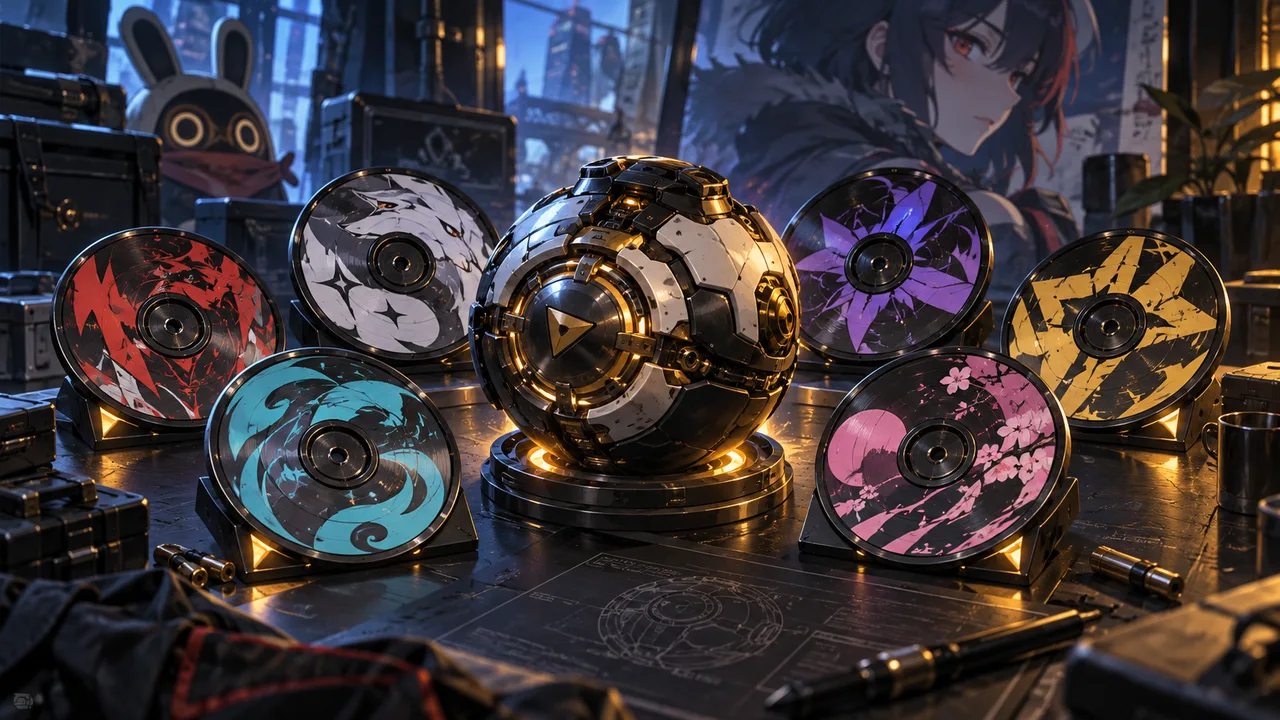
Original AI-assisted fan illustration for Zenless Hub. Artwork & editorial policy.
A disc is useful when its stats and effect serve the Agent’s job. A rare piece with the wrong main stat can be less helpful than a modest piece that improves the action your team needs.
Start with the role
An attacker focused on critical hits values a different package from an Agent whose job is to build Daze or supply support. First read the Agent’s scaling and important skills. Then choose the attributes that support those mechanics.
Do not copy another Agent’s equipment because both share an element. Attribute, specialty, scaling and field time all influence what the build needs.
Check slots before substats
The first three disc slots have fixed main-stat categories, while later slots offer choices. Those flexible slots often create the largest decision. For example, a conventional stunner can prioritize Impact in slot 6, while a support may prefer Energy Regen to perform its useful action more often.
Our Anby build, Nicole build and Billy build show these different priorities in a familiar starter squad.
The available flexible-slot main stats
| Slot | Main-stat pool |
|---|---|
| 4 | HP%, ATK%, DEF%, CRIT Rate, CRIT DMG, Anomaly Proficiency |
| 5 | HP%, ATK%, DEF%, PEN Ratio, attribute damage bonus |
| 6 | HP%, ATK%, DEF%, Impact, Energy Regen, Anomaly Mastery |
A disc has up to four substats. Its main stat cannot also appear as an identical substat; flat ATK and ATK% are distinct. Impact and Energy Regen are main-stat decisions, not ordinary substats to hunt on every slot. The standard substat pool covers flat and percentage HP/ATK/DEF, CRIT Rate/DMG, flat PEN and Anomaly Proficiency. Stat-pool reference.
Standard level caps are +9 for B-rank, +12 for A-rank and +15 for S-rank. Enhancement checkpoints add a missing substat until four exist, then upgrade one of them. Disc enhancement reference.
Read the complete set effect
Use this starter-team comparison while inspecting the flexible slots. These are role-specific starting points; the linked builds explain the alternatives and set requirements.
| Agent and job | Disc 4 | Disc 5 | Disc 6 |
|---|---|---|---|
| Anby: Stun | CRIT Rate | Electric DMG or ATK | Impact |
| Nicole: Support | ATK or Anomaly Proficiency | Ether DMG or ATK | Energy Regen |
| Billy: Attack | CRIT Rate or CRIT DMG | ATK; compare alternatives in the full build | ATK |
Slots 1, 2 and 3 use HP, ATK and DEF main stats respectively. Substats can still differ between pieces. Check the slot number first so you do not look for a main stat that cannot appear there.
A two-piece stat bonus is easy to compare. A four-piece effect may depend on a particular attack, event or team action. Ask whether the Agent will trigger it during your real rotation, and whether the bonus helps the character who needs it.
An effect with difficult conditions can underperform an uncomplicated alternative in your hands. Conversely, a team built around that effect may use it very well. Equipment recommendations need that context.
Upgrade with a stopping rule
Lock promising pieces before recycling anything. Upgrade a usable main-stat piece enough to improve your next attempt, then reassess. Avoid destroying your current functional set while assembling a theoretical replacement.
| Question | What the answer tells you |
|---|---|
| Is the main stat useful? | Whether the piece deserves initial consideration |
| Can I activate the set effect? | Whether the bonus exists in this rotation |
| Are the substats relevant? | Whether it is worth further investment |
| Does another upgrade solve a bigger problem? | Whether to pause disc farming |
A complete-piece comparison
Suppose two finished sets leave Billy at 60% CRIT Rate / 120% CRIT DMG and 45% / 150%, with identical ATK, damage bonuses and effects. For attacks that can crit, their average critical factors are 1 + 0.60 × 1.20 = 1.72, versus 1 + 0.45 × 1.50 = 1.675. The first package has the higher average factor despite its smaller CRIT DMG number.
This is a simplified arithmetic example, not a damage test. A short fight can vary, and changing ATK, set uptime or combat buffs changes the comparison. The Billy build supplies a separate disc-5 example.
Compare complete builds
Record your stats and try the same encounter before and after a change. A single attractive stat does not capture the whole build. Keep enemy conditions and your rotation similar so the comparison means something.
Build suggestions here are accessible starting points. Consult the linked references in each character’s build and the current in-game equipment descriptions for exact effects; new sets can create alternatives over time.
Published September 16, 2026 · Updated September 20, 2026 · See our editorial policy
Source-based editorial guidance. References and the scope of examples are identified in the article. How this content is reviewed.